

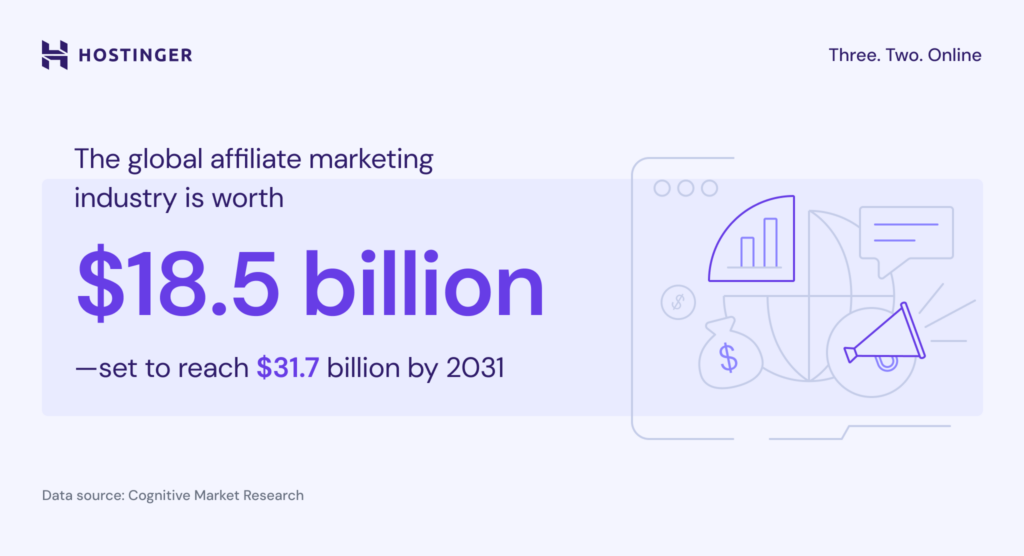
The affiliate and partner marketing landscape in 2026 is undergoing profound transformation, driven by rapid technological advancements. The global affiliate marketing industry is valued at approximately $18-20 billion and is projected to grow significantly, with some estimates pointing toward $30 billion+ by the early 2030s. This growth isn’t just about scale—it’s about sophistication. Technologies like artificial intelligence (AI), privacy-compliant tracking, and automation platforms are reshaping how merchants, partners, and creators collaborate.
Affiliate marketing statistics 2026: Trends & key insights
Global affiliate marketing industry growth highlights the increasing adoption of advanced technologies.
Traditional models relied on simple link tracking and manual management. Today, the ecosystem emphasizes efficiency, personalization, data-driven decisions, and ethical practices amid evolving privacy regulations. This in-depth guide explores the key technological shifts, their impacts, real-world applications, and what they mean for affiliates, merchants, and platforms in 2026.

Market Landscape Map: Affiliate Tech (Updated July 2024) – Martech …
The affiliate tech ecosystem in 2026 features interconnected tools for tracking, automation, and AI integration.
1. Artificial Intelligence: From Assistant to Strategic Partner
AI has moved beyond hype to become a core component of affiliate and partner marketing.
Key Applications:
- Content Creation and Optimization: Tools generate drafts, suggest keywords, and optimize for search intent. However, human oversight ensures authenticity—Google’s EEAT guidelines prioritize expert, trustworthy content.
- Personalization: AI analyzes user behavior to recommend tailored partnerships or dynamic creatives, boosting conversion rates.
- Fraud Detection: Machine learning identifies invalid traffic patterns in real-time, protecting payouts.
- Predictive Analytics: Forecasts performance, suggesting optimal partner matches or commission adjustments.

Best AI Tools for Affiliate Marketing
AI tools are revolutionizing content strategies and performance optimization in affiliate marketing.
In partner ecosystems, AI powers “agentic” systems that automate workflows, such as partner onboarding or co-selling coordination. For example, platforms use AI to match brands with creators based on audience overlap and past performance.
Experts note that by 2026, AI is shifting from tactical tool to strategic asset, with many programs integrating it for competitive advantage.
2. Privacy Evolution: Cookieless Tracking and First-Party Data
Third-party cookie deprecation (completed across major browsers by 2025) forced a pivot to privacy-first solutions.
Modern Tracking Technologies:
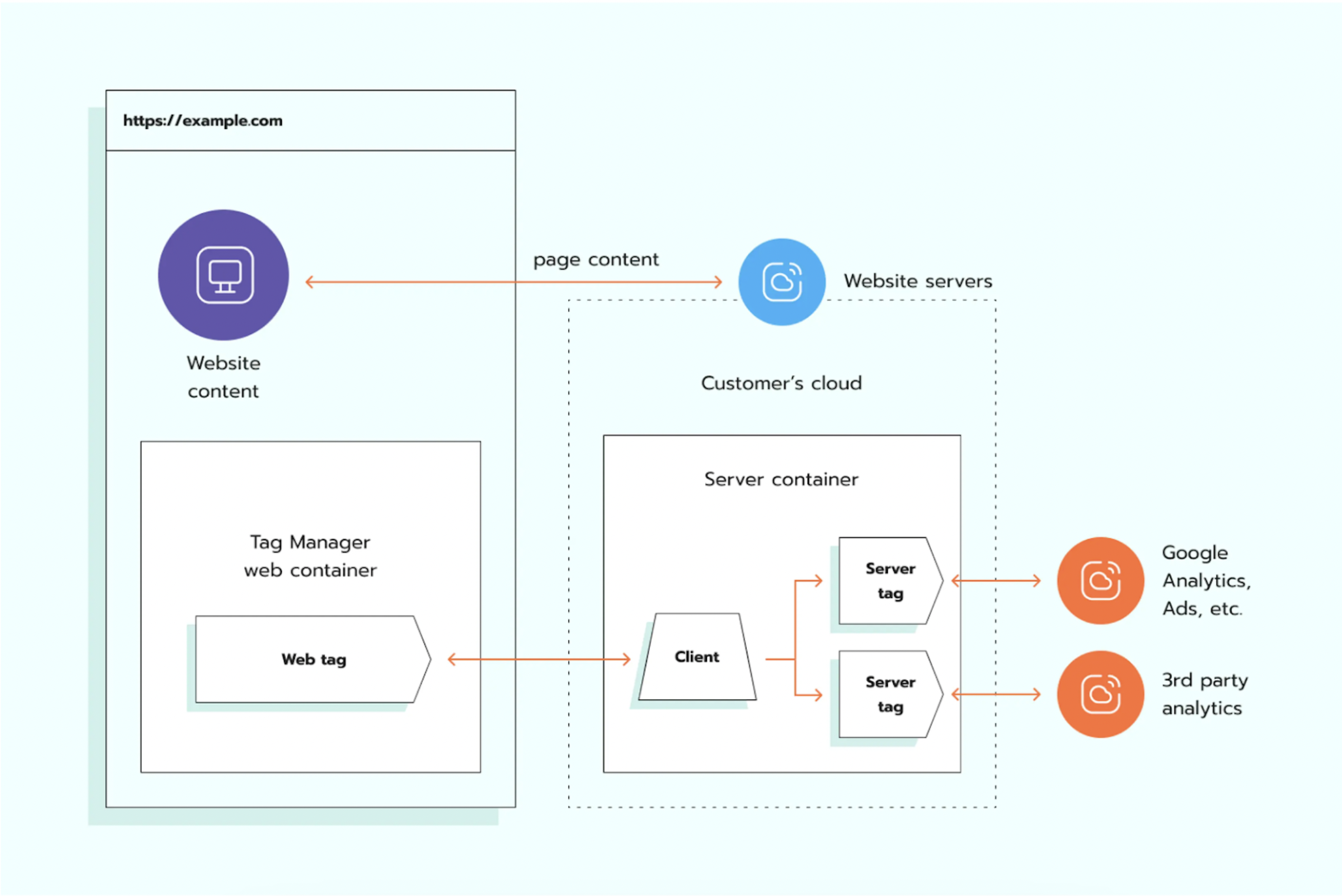
- Server-to-Server (S2S): Direct communication between merchant servers and platforms for reliable attribution.
- First-Party Data and Contextual Signals: Brands leverage owned data (e.g., email logins) and probabilistic modeling.
- Universal IDs and Clean Rooms: Privacy-safe data sharing for cross-platform insights.
What is Cookieless Tracking and How to Implement
Cookieless tracking relies on server-side and first-party methods to maintain accuracy in a privacy-focused world.
This shift benefits ethical marketers: Accurate, consent-based tracking builds long-term trust. Platforms like Impact.com and PartnerStack have invested heavily in these technologies, enabling multi-touch attribution without invasive cookies.
Result: More transparent ecosystems where high-quality partners thrive.
3. Automation: Streamlining the Partnership Lifecycle
Partnership automation platforms have evolved from basic networks to comprehensive systems managing the entire lifecycle.
Core Features in 2026:
- Automated onboarding, contracts, and payouts.
- AI-driven partner discovery and recruitment.
- Integrated CRM for relationship management.
- Real-time dashboards with predictive insights.
impact.com – The All-in-One Partnership Management Platform
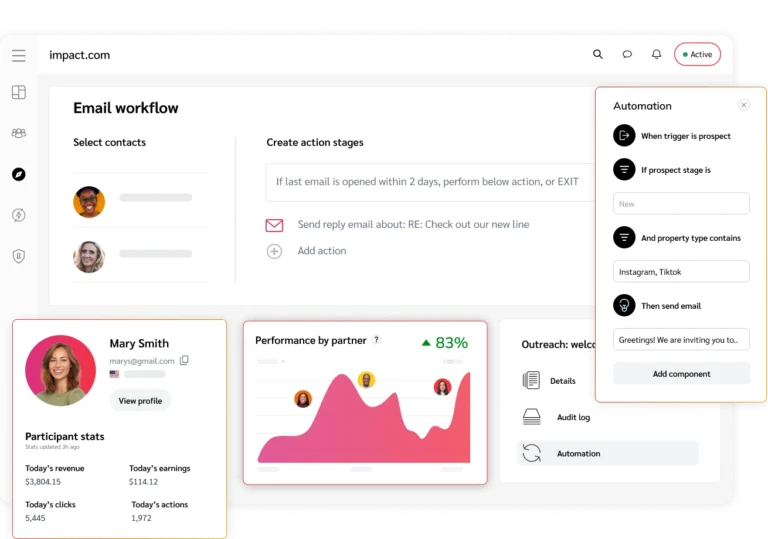
Advanced partnership platforms provide unified dashboards for managing diverse partner types efficiently.
Platforms like Impact.com, PartnerStack, and newer entrants handle affiliates, influencers, referrals, and B2B resellers in one place. This consolidation reduces administrative burden, allowing focus on strategy.
For content creators, automation means easier access to opportunities and faster payments.
4. Advanced Attribution and Data Analytics
Accurate crediting of partnerships has improved dramatically.
Evolution in Attribution Models:
- From last-click to multi-touch and data-driven models powered by AI.
- Incorporation of offline influences and cross-device journeys.
Analytics tools provide deeper insights: Partner lifetime value, incremental lift, and channel interplay.
This transparency helps merchants optimize budgets and rewards top performers fairly.
5. Creator Economy Integration and Social Commerce
The rise of user-generated content (UGC) and social platforms blurs lines between affiliates and influencers.
Tech-Driven Changes:
- Direct integrations with TikTok, Instagram, and YouTube for seamless tracking.
- Hybrid commission models combining affiliates with performance bonuses.
- Tools for creator discovery and management.

Affiliate Marketing: Tips, Tricks, and Best Practices for 2026
Modern affiliate flows incorporate social commerce and creator partnerships for broader reach.
Social commerce is projected to exceed $100 billion in 2026, driving hybrid deals where creators earn from both content and sales.
6. Emerging Technologies on the Horizon
- Voice Search Optimization: Content adapts for conversational queries.
- Blockchain for Transparency: Potential for immutable payout records (early adoption).
- Agentic AI: Autonomous systems handling negotiations or optimizations.
These promise further efficiency but require careful ethical implementation.
Challenges and Considerations
Rapid change brings hurdles:
- AI Ethics: Avoiding over-reliance that erodes authenticity.
- Data Privacy Compliance: Navigating GDPR evolutions and new regulations.
- Skill Gaps: Need for upskilling in AI and analytics.
- Consolidation Risks: Fewer but more powerful platforms.
Successful players prioritize transparency, human oversight, and value-driven partnerships.
Key Technological Impacts: A Comparison
| Technology | Primary Impact | Benefits | Challenges | Leading Platforms/Tools |
|---|---|---|---|---|
| AI | Content, personalization, fraud | Efficiency, higher conversions | Authenticity risks | Integrated in most modern platforms |
| Cookieless Tracking | Privacy-compliant attribution | Accurate in regulated environments | Reduced signal strength | Impact.com, server-side solutions |
| Automation Platforms | Lifecycle management | Scalability, reduced admin | Learning curve | PartnerStack, Impact.com |
| Advanced Analytics | Multi-touch insights | Fairer crediting, optimization | Data complexity | Built-in dashboards |
| Social Integrations | Creator and commerce blending | Broader reach | Platform dependency | Native tools on social media |
The Future Outlook for 2026 and Beyond
Technology is making affiliate and partner marketing more efficient, inclusive, and resilient. The ecosystem is shifting toward integrated platforms that support diverse partnerships while respecting privacy and authenticity.
For affiliates and creators: Leverage AI tools ethically to scale content and choose platforms with strong tech stacks.
For merchants: Invest in automation and first-party data for sustainable growth.
Platforms like Impact.com for comprehensive automation or PartnerStack for recurring SaaS partnerships exemplify these advancements.
The winners in 2026 will blend cutting-edge technology with human-centric strategies—delivering real value in an increasingly digital world.
